

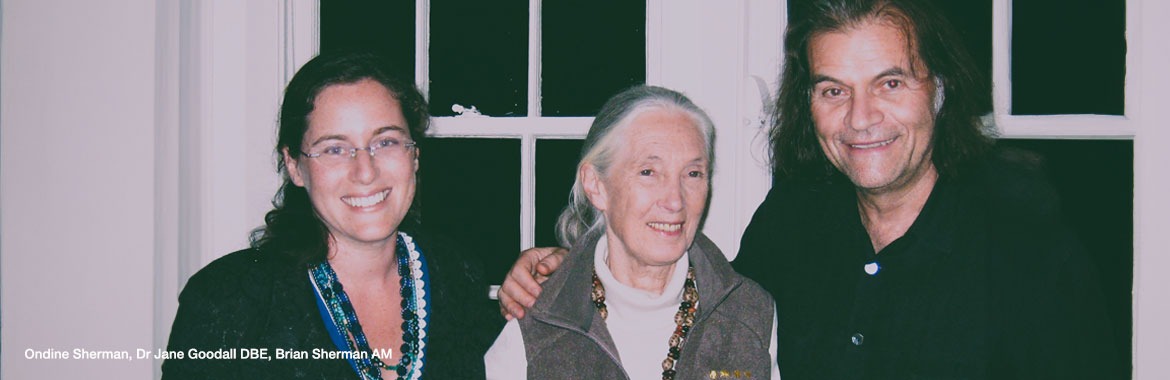
Ondine Sherman, Dr Jane Goodall DBE, Brian Sherman AM in 2008
In the last days, tributes to the indomitable Dr Jane Goodall, DBE, have overflowed. For the best reasons.
A pioneering primatologist and anthropologist, Dr Goodall was first renowned for her groundbreaking, decades-long study of wild chimpanzees at Gombe Stream National Park in Tanzania, which revolutionised understandings of chimpanzee behaviour. With her innovative methods, she showed how chimps not only use tools but also possess complex social and emotional lives. To Jane, they were individuals, not numbers. Wanting to protect the animals and wildlife with whom she had become deeply connected from the terrible, looming fates of violence, death, and extinction, she founded the Jane Goodall Institute and Roots & Shoots. A global advocate for conservation, animal protection, and youth activism was born.
However, fewer people know that Jane also supported diverse people and causes, often quietly, which was how she came to be a Voiceless Patron, treasured by my father (and Co-founder), Brian Sherman and me.
I was fortunate to meet the tiny team of volunteers at Jane Goodall Institute Australia before they registered, and I became a founding member. My father and I first met Jane at an intimate dinner in a private house in Sydney: she had just flown into Australia, incredibly jetlagged, to continue a worldwide speaking tour. After dinner, we requested a private conversation; Jane had been awake for twenty-four hours at this point and looked on the verge of fainting from exhaustion, but she graciously agreed. We sat with her in a darkened room, as the light bothered her, away from the other guests. With her eyes closed, she listened carefully to the mission and vision for our organisation, Voiceless. She promised to help however she could—and she did, by becoming a beloved Voiceless Patron in 2011, together with Hon Michael Kirby AC CMG and John M. Coetzee AC FRSL OMG
Over the years that I had the pleasure of seeing her and exchanging emails, she defied the saying “never meet your heroes”.
Here are three of my favourite things about our Voiceless Patron, Dr Jane Goodall.
1. A Fly is a Chimp is a Pig
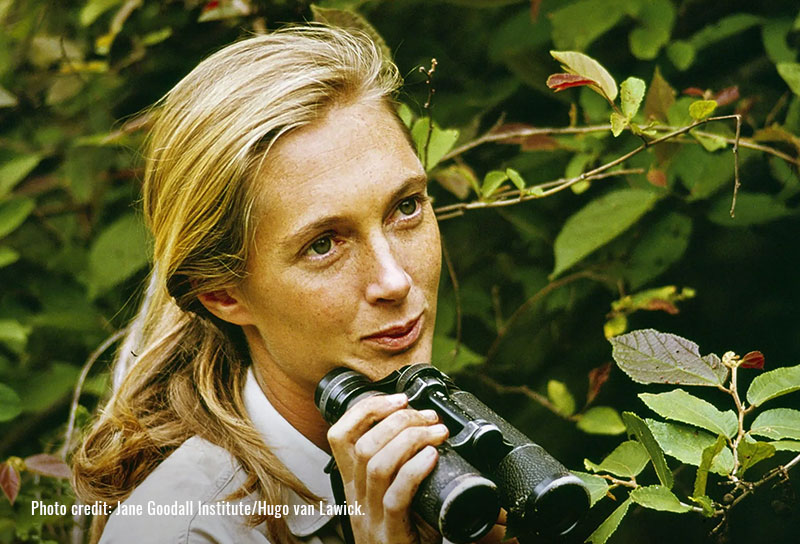
Jane was one of the rare individuals who spanned both the environmental and animal protection movements. Coming from an environmental protection background myself, I was continuously disappointed to see environmental leaders ignore the mass suffering of animals in factory farming. I cared about the environment and animals. But that was deemed strange. Jane was a unique voice: a global advocate for nature, wildlife, and all animals. No hierarchy, no categorisation, no labels.
I remember sitting in the forest one day alone and this beautiful fly… I’ve never seen one before or since. It was all sorts of colours, only about this big, and it settled on my knee, and I looked at it, and my mind immediately said, “it’s a fly”. As soon as you say it’s a fly, you take away from the magic. We can’t help but do it; that’s how we’re brought up. Something must have a name. But I tried really hard in that moment to just think of it as a being, as a part of this natural, beautiful tapestry of life. And so, for me, it’s as though it’s one connected whole, me and the wilderness, the wildlife around me and if I have a soul, then it’s a little piece of this amazing harmony, the spirit, and if I have this, then so does that little fly and the butterfly and the tree that we’re sitting on.
Dr Goodall was not only an advocate for wild beings, but also for all animals whose voices we refuse to hear, considered of value only for their meat, skins and milk. She argued that “cramming” animals into tiny spaces, inflicting cruelty, in factory farming systems was unacceptable, and the shocking scenes from inside farms kept her awake at night.
Thank you, Jane, for not discriminating against species, for not assigning them into categories according to their value to humans, for treating all Earth’s beings as worthy of our awe, respect and protection.
2. The Promise and Power of Youth and Education

Jane Goodall inspired me with her work on Roots & Shoots, a global network that encourages youth to take action to make the world a better place for animals, people, and the environment. She argued that young people are often passionate about making a difference in the world; they are our most valuable change-makers and will be instrumental in creating a kinder, more compassionate world for animals.
I believe that humane education is extremely important… Once children understand that animals have feelings much like themselves, they are more likely to be kind to them
Jane’s focus on youth aligns with increasing scholarship indicating that children are more pro-animal and less accepting of animal cruelty than adults. As we grow older, social norms of animal exploitation come into play. Therefore, reinforcing and encouraging values of protection and connection to animals can help youth resist the dominant culture and grow into empathetic pro-animal adults.
Reading about her passion for fostering respect for animals in children reminded me of my early beginnings, and I felt a kinship. Like many animal people, Jane and I both shared a love for all animals from our earliest memories. As a little girl, I’d worry about ants and write little picture books about how they feared being stomped on by us giant humans. Here Jane describes her love for worms:
I was born with a fascination for animals. My mother came to my room to say goodnight once when I was 1 ½ years old and found my bed full of earth and earthworms. She said I was watching them so intently – she thought perhaps I wondered how they moved without legs! Her support of my love for animals was really important – she did not get angry, but simply said they would die if we did not return them to the garden. I agreed but cried a bit, apparently!
Her Roots & Shoots work was the spark that led me to launch Voiceless’s first education program for children, Animal Club, back in 2006. Voiceless then developed a larger Animal Protection Education programme for Australian high schools, used by tens of thousands of students. My desire to inspire young people to make a positive impact on animals also led me to write my YA book series, Sky, Snow, and Star. Today, Voiceless continues Jane’s legacy through our grants program — inspiring a new generation to protect animals with compassion and courage. Thank you, Jane.
3. Grit and Resilience
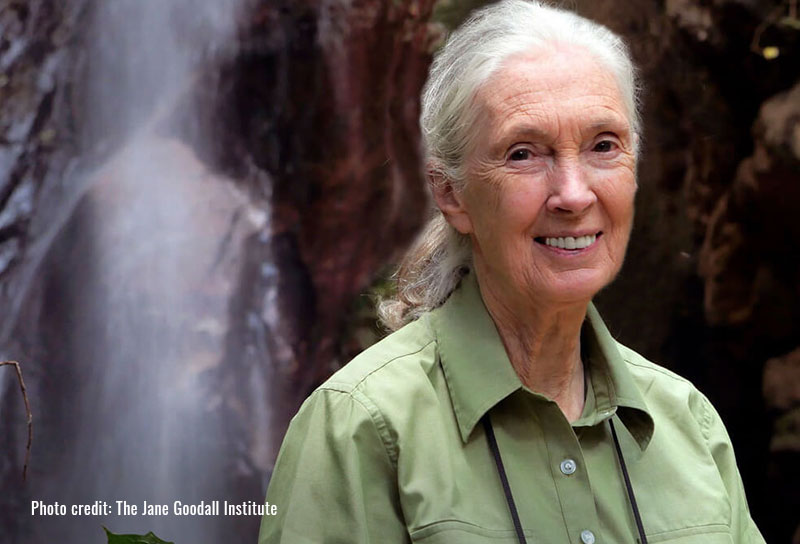
Many thought leaders have discussed the importance of grit, resilience and tenacity for a successful life.
Grit is a steadfast persistence while pursuing our long-term goals. It’s not a sprint, but a show of both passion and perseverance; refusing to give up when things get tough, never losing sight of our ultimate objectives. Jane was a leading example. At ninety-one, she was on a US speaking tour, raising awareness about the same issues she had focused on throughout her entire adult life: advocating for an end to factory farming, compassion for animals and for the protection of our natural world. These issues are far from being solved, quite the opposite – 80 billion farmed animals and trillions of fishes are now slaughtered each year, with numbers rising. Our oceans are decimated. The climate crisis continues, with catastrophic consequences. Deforestation, wildlife trading, hunting, racing…
The challenges remain immense. But Jane didn’t give up, and neither can we. We keep working, striving, trying, hoping. Because that is all we can do. Despair, according to Jane, is self-indulgent. “If you care, you cannot give up. Hope is not passive — it’s about action.”
Thank you, Jane, for reminding me —and so many others —to never give up. Even when the world looks dire, and humans appear uncaring and uncompassionate… Our work, our mission, is to continue. We still have a long road ahead, but I hope and believe that you have left behind a generation of young people who will continue your legacy. As you reminded us, every day, we can make an impact on the world and on the people around us. You certainly did.
To revisit our conversation with Jane and her reflections on compassion and hope, read our 2011 interview here.